Scientia for Slack
Slack tells you what happened. Scientia remembers what was decided — and why.
Scientia captures decisions right in your Slack threads and turns them into structured, evidenced records you can review, approve, and revisit. Slack is the first capture surface. Scientia is the durable decision system.
Native Slack integration · currently available to approved pilot workspaces.
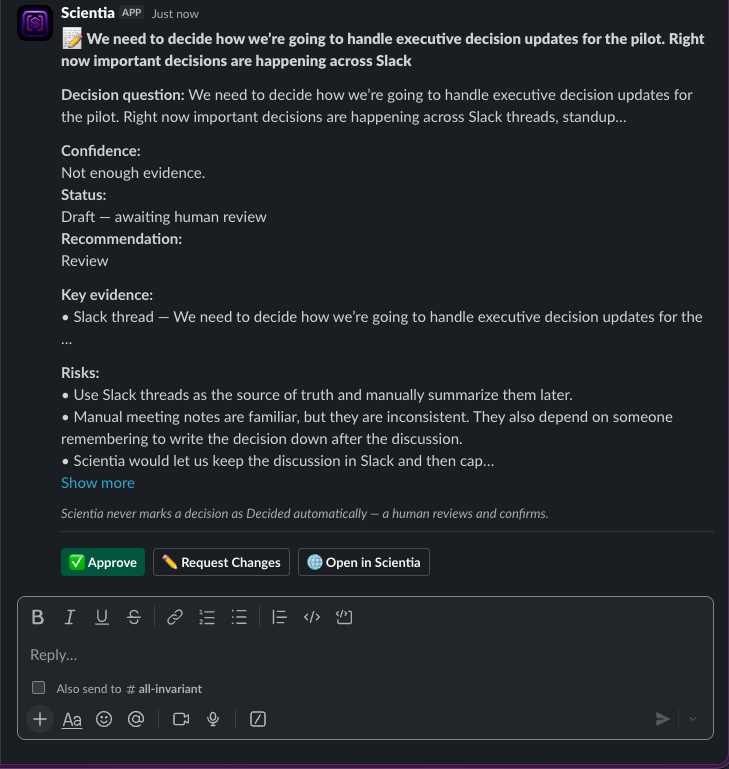
How decision capture works in Slack
From a thread to a decision you can trust later.
Scientia is not a general-purpose assistant or a thread summarizer. It captures the decisions that would otherwise be lost in the scroll, and keeps them structured, evidenced, and reviewable.
1 · Capture
In the thread
Run /scientia capture or mention @Scientia. Scientia grounds the draft in the available Slack thread and surfaces when the context is insufficient.
2 · Structure
A real decision record
The discussion becomes a structured record — the question, the evidence, and the rationale — not a summary of the chatter.
3 · Review
Approve in Slack
A Decision Card appears in the thread. Approve promotes it to your Decision Log; Request Changes opens a modal to say what needs to change.
4 · Remember
Durable memory
App Home keeps Pending Reviews and Recent Decisions in reach, and decision-memory search answers what was decided — honestly, including when nothing is on record.
OAuth workspace connection · bot tokens encrypted at rest · per-workspace isolation · request signature verification. See how Scientia for Slack works →
The pilot
A narrow pilot for teams with live decision-structure pain.
This pilot is for teams that need important decisions to stay structured, evidenced, and reviewable over time — not buried across meetings, memory, and scattered tools. Access is guided, not self-serve.
Who this is for
Founder-led and operator-led teams already feeling decision-structure pain in live work, not hypothetical future process design.
What the pilot is testing
Whether capturing decisions through Slack keeps important calls structured, evidenced, reviewable, and less dependent on oral history.
Why access is guided
The pilot stays narrow by design so the team can evaluate real fit, real decision ownership, and a real feedback loop.